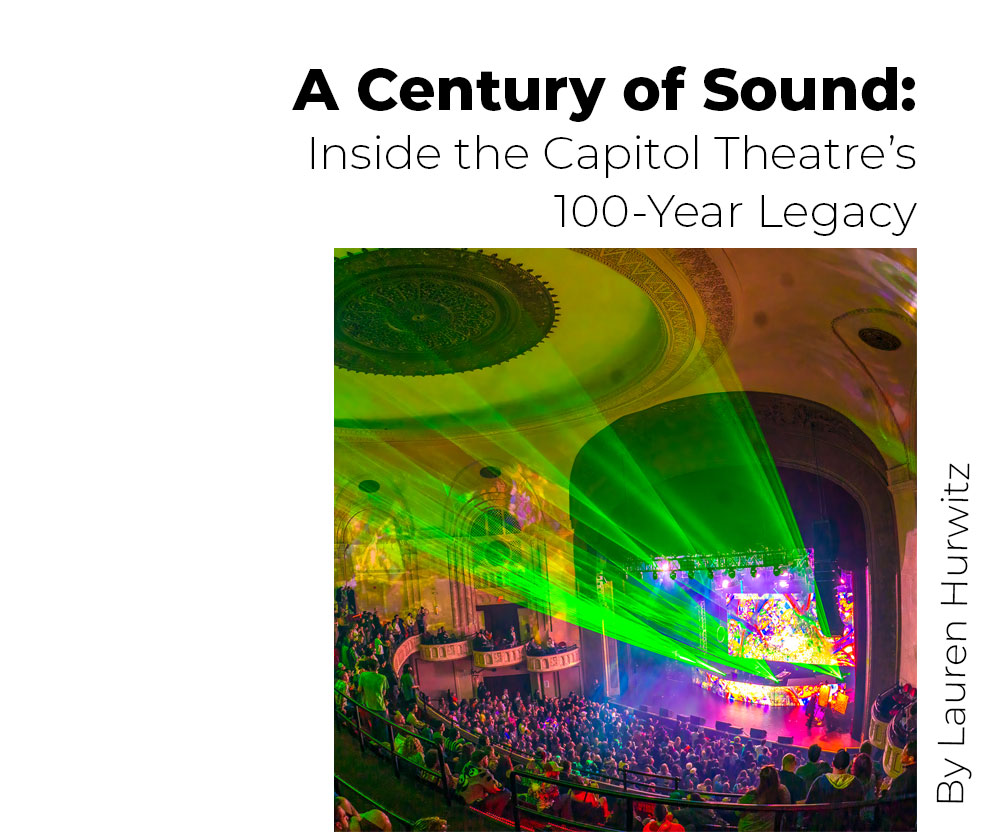
On August 28, 1926, entertainment in Westchester County changed forever.
That summer night, the doors of the Capitol Theatre opened for the first time in Port Chester, ushering in a new era of culture, community, and live performance. Nearly a century later, the iconic venue – now celebrating its 100th anniversary – stands not only as a beloved local landmark, but as one of the most legendary live music theaters in the world.
Built during the golden age of vaudeville and silent film, the Capitol Theatre was originally designed as a grand entertainment palace. Opening just 10 days after its official August 18, 1926 debut, the theater proudly advertised itself as Westchester County’s first air-conditioned venue. At the time, this was a novelty so enticing that an open letter was sent throughout Port Chester inviting residents to experience comfort and culture under one ornate roof.
 Designed by renowned architect Thomas Lamb, whose portfolio included some of New York City’s most iconic theaters, the Capitol was meant to impress. With soaring ceilings, intricate details, and impeccable acoustics, it was a space built to elevate performance, and it quickly became the beating heart of live entertainment north of Manhattan.
A Rock & Roll Legend Is Born
While the Capitol’s early years were defined by variety shows and film, it was the 1970s that cemented its place in music history.
“Every major rock and roll artist came through here,” says Stefanie May, the theater’s Marketing Director. “The Capitol Theatre became a destination not just for fans, but for artists.”
Few bands are as closely tied to the venue as the Grateful Dead, who played the Capitol Theatre 18 times between 1970 and 1971 alone. Many of those shows were recorded by ushers Ken and Judy Lee using equipment discreetly hung from the balcony and were never officially released yet they took on a life of their own. Traded hand-to-hand and eventually shared globally, the recordings became legendary among Deadheads worldwide.
“The Capitol Theatre became famous because of those shows,” says Emily Schmalholz, Head of Special Events. “People all over the world know this venue because of what happened here.”
The list of artists who graced the Capitol Theatre’s stage during that era reads like a rock and roll hall of fame: Pink Floyd, Jefferson Airplane, Janis Joplin, Frank Zappa, and countless others.
One of the Capitol Theatre’s most iconic moments came when Janis Joplin debuted Mercedes Benz on its stage just days after scribbling the lyrics on a napkin at a nearby bar. That first performance can still be heard today, preserved in recordings that continue to circulate online.
Reinvention, Revival, and a New Era
Like many historic venues, the Capitol Theatre experienced periods of uncertainty. By the late 1990s and early 2000s, the building had fallen into disrepair and was no longer functioning as a full-time music venue.
That changed in 2012, when legendary music entrepreneur Peter Shapiro, best known for founding Brooklyn Bowl, led a multimillion-dollar restoration that returned the Capitol Theatre to its former glory while equipping it for the modern era. The reopening was marked by Bob Dylan taking the stage for the first show of the new era.
Behind the scenes, nearly everything had been upgraded from the state-of-the-art sound, to the lighting, and the projection systems now coexisting seamlessly with historic architectural details. Today, the walls themselves are digitally mapped, capable of transforming the space into anything from a star-filled sky to a destination-themed celebration.
“You can get married under the stars here,” Emily explains. “We’ve done bar and bat mitzvahs that feel like you’re in Israel. The transformation is unbelievable.”
More Than a Concert Hall
While the Capitol Theatre remains a premier live music venue with a capacity of 2,000 standing or 1,500 seated, it has also evolved into one of Westchester’s most dynamic event spaces.
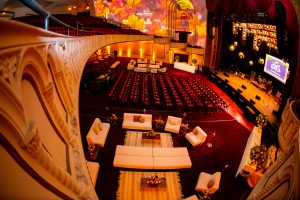
Each year, the venue hosts 40 to 50 private events, ranging from milestone birthdays and weddings to large-scale corporate celebrations. For select events, the theatre floor is leveled entirely, converting the concert hall into a sweeping, immersive event space.
Adjacent to the main theatre is Garcia’s, an intimate 250-person bar and music club named for Jerry Garcia in partnership with his family. Originally part of the theatre’s lobby, Garcia’s now operates as its own venue several nights a week, hosting live music, private events, and the beloved weekly “Dead Center” Wednesdays. “One of the biggest misconceptions is that we’re just a jam band venue,” Stefanie says. “There’s so much more happening here.”
Music With a Mission
The Capitol Theatre has also become a powerful force for philanthropy. Annual initiatives like Rock the Pink raise funds for breast cancer awareness through ticket donations, merchandise, and drink specials, while partnerships with organizations like Pace Women’s Justice Center have transformed concerts into life-changing fundraisers.
One standout event featured Sara Bareilles, selling out in minutes and raising critical funds for survivors of domestic abuse. Subsequent years brought performances by the Indigo Girls, Colbie Caillat, and Shawn Colvin.
“There’s something incredibly powerful about bringing people together through music to support a cause,” Emily says. “You can feel it in the room.”
Looking Ahead to 100 Years—and Beyond
To celebrate its centennial, the Capitol Theatre is planning a yearlong celebration that includes a special anniversary concert, commemorative merchandise, and a refreshed brand identity featuring a 100-year logo. A new digital history guide, launching on Bloomberg Connects, will allow visitors to explore rare photos, stories, and firsthand accounts from ushers, promoters, and artists who shaped the theatre’s legacy.
Perhaps most striking is the Capitol Theatre’s leadership today: the General Manager, Head of Special Events, Head of Marketing, Head of Human Resources, and key technical staff—including its projectionist—are all women.
In an industry historically dominated by men, the Capitol Theatre is quietly rewriting the narrative.
At its core, the Capitol Theatre has always been about connection between generations, between artists and audiences, between history and what comes next. As it enters its second century, one thing is certain: the music…and the magic…is far from over.