

 As America approaches its 250th birthday, the real story of the Revolution starts closer to home and with the women history almost forgot. We find ourselves returning to the familiar stories – founding fathers, battlefield strategy, and the fight for independence. But here in Westchester, the story feels closer, more personal, and for a long time, largely untold.
“What we learned in school was very male-focused…it was about the battles,” says Barbara Davis, Executive Director of the Westchester County Historical Society and City Historian of New Rochelle. “Now, thanks to digitized records, we’re seeing a much fuller picture. And women were a huge part of it.”
That fuller picture reveals a region unlike anywhere else in the colonies. During the Revolutionary War, Westchester became known as the “Neutral Ground,” positioned between British-controlled New York City and Patriot territory to the north. In reality, there was nothing neutral about it.
 For nearly seven years, the area existed in a state of constant instability, with armed bands – often referred to as Cowboys and Skinners – moving from farm to farm, stealing food, livestock, and anything of value. It was unpredictable, often violent, and deeply personal, with neighbors sometimes finding themselves on opposing sides of the conflict.
As many men left to fight – some for the British, others for the Patriots – the responsibility of keeping life going fell squarely on the women who remained.
“They left to fight, sometimes for opposite sides,” Davis explains. “So who was holding everything together? The women.”
And they did far more than simply “hold it together.” Women took on the full weight of daily life, managing farms, raising large families, and protecting their homes under constant threat. In many cases, they were doing not only their own work, but also the work their husbands had left behind.
Stories like that of Susan Valentine of Yonkers offer a glimpse into just how much was demanded of them. When a group of armed men approached her home, she met them at the door, gripping an oversized oven shovel and warning that she would strike anyone who tried to enter. It was a moment of sheer resolve and one that, at least temporarily, kept her home safe.
Not every encounter ended that way. Women were robbed, threatened, and, at times, physically attacked, yet their resilience shows up again and again in the historical record.
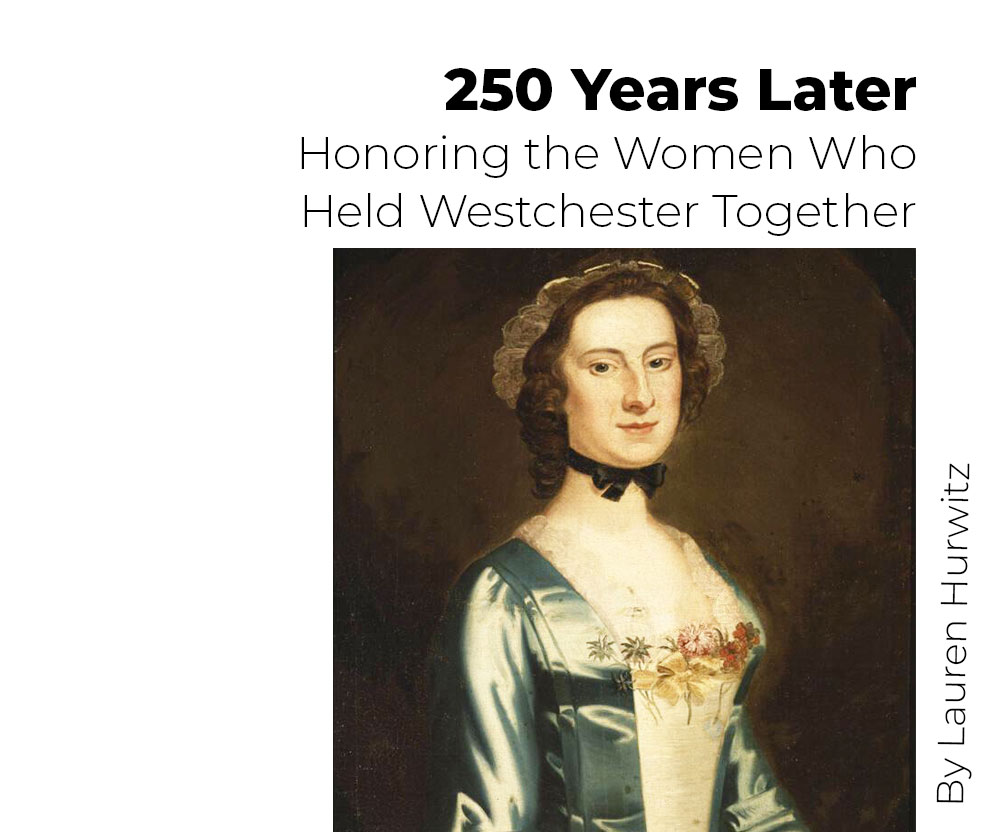
What makes Westchester’s story even more complex is that there was no single “side” for many of these women. The county was deeply divided, with Loyalist and Patriot loyalties often splitting families and communities. Mary Philipse Morris, one of the wealthiest women in the colonies, was ultimately declared a traitor for her allegiance to the British, and her land was seized. Others, like Susanna Philipse Robinson, actively supported Loyalist forces, reinforcing how layered and personal these decisions were.
“The American experiment was incredibly improbable,” says Yonkers City historian, Mary Hoar. “At a time when women were expected to be quiet, obedient, and controlled, they stepped into roles no one had prepared them for.”
Those roles took many forms. Some women, like Margaret Odell, fought back physically to protect their families, even at great personal risk. Others, like Lorenda Holmes, became couriers, navigating dangerous territory to deliver messages and guide troops.
Even the routines of daily life carried political weight. Tea, for example, became both a symbol of resistance and a source of tension. While men could gather publicly and abstain together, women were often expected to manage those sacrifices quietly at home. In Westchester, however, some chose a different path.
In what became known as the Westchester Tea Parties, groups of women organized and confronted merchants who were hoarding tea, demanding fair access and refusing to be sidelined. Riding on horseback and acting collectively, they asserted themselves in ways that challenged both social expectations and wartime norms.
“These women were not passive,” Hoar notes. “They were engaged, determined, and willing to assert themselves – even when it wasn’t expected of them.”
Some women went even further, stepping directly into military roles. Deborah Sampson disguised herself as a man and enlisted in the Continental Army, serving in dangerous missions across the region, including Westchester. After being wounded in battle, she is believed to have treated her own injuries rather than risk revealing her identity.
Others contributed in ways that were less visible but no less critical. In North White Plains, Ann Fisher Miller opened her home to General George Washington, allowing it to serve as a headquarters during the Battle of White Plains. After losing her husband in the war, she continued to manage the farm, care for her family, and nurse wounded soldiers, embodying the kind of quiet strength that defined so many women of the time.
For centuries, these contributions were often treated as side notes, if they were acknowledged at all. Today, however, newly digitized records including firsthand accounts collected decades after the war are helping to bring these stories into clearer focus.
What emerges is a version of history that feels less distant and far more human.
Because the Revolutionary War was not only fought on battlefields. It unfolded in kitchens, barns, and along rural roads, in moments of uncertainty and fear, when survival depended on quick decisions and steady resolve.
And through all of it, life continued.
Farms endured. Families were sustained. Communities, though tested, found ways to rebuild.
As Westchester begins to commemorate America’s 250th anniversary with reenactments, exhibitions, and local programming, the opportunity is not just to celebrate history, but to reconsider it.
To recognize that the foundation of this country was not built solely by the figures whose names fill our textbooks, but also by those who remained behind, adapting to impossible circumstances and ensuring that there was something left when the war was over.
Here in Westchester, that story belongs, in large part, to the women who never left and who made sure everything else survived.