

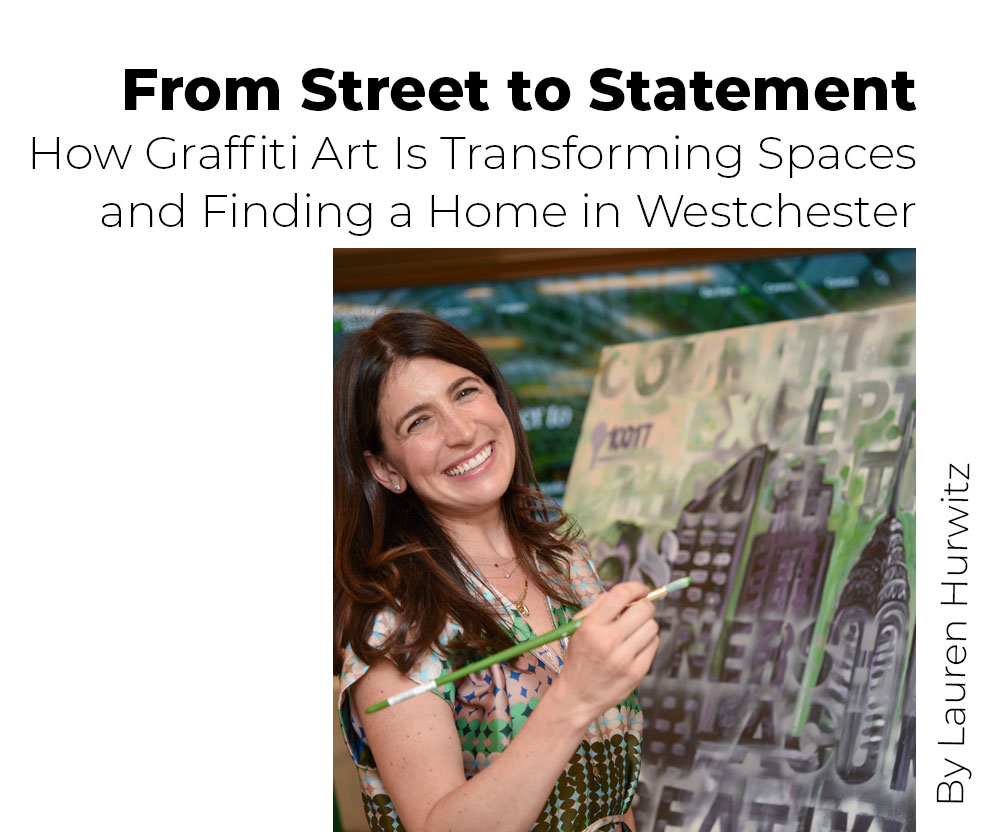
Graffiti has long carried a certain edge, bringing to mind spray-painted subway cars, city walls, and late-night acts of rebellion. But that narrative is shifting. What once lived on the margins is now being welcomed into homes, businesses, and community spaces, reimagined as something deeply personal, expressive, and, increasingly, joyful.
In places like Westchester County, graffiti art is no longer about defiance. It is about connection, storytelling, and creating spaces that feel alive the moment you walk into them. For artists like Sara Joy, that shift is not just a trend. It is the foundation of her work and the reason her vibrant, graffiti-inspired pieces are resonating so strongly right now.
“I use art to make myself and everyone around me smile” says Sara Joy, an Ardsley-based artist whose work can be found everywhere from stylish children’s bedrooms to contemporary women’s boutiques filled with energy and color. “That’s my purpose.”
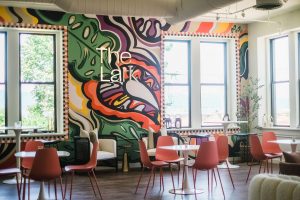 Her perspective reflects a broader movement in the art world, where street art has steadily gained legitimacy and demand over the past decade. According to reports from Art Basel and UBS, urban and street art have become some of the fastest-growing segments of the global art market, with collectors and homeowners increasingly drawn to work that feels raw, immediate, and emotionally engaging rather than overly traditional.
Sara Joy’s work fits naturally within that evolution, but what makes it stand out is how seamlessly it translates graffiti’s boldness into everyday life. Her business is built around three core offerings: large-scale murals, custom paintings, and art workshops she calls “Art Parties”. Each one is designed not just to decorate a space, but to transform how it feels.
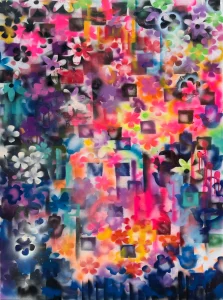 Her custom murals have appeared in places like The Lark, a women’s fitness studio, a pool club makeover in Northern Westchester, and large walls of newly renovated Westchester homes, bringing a sense of movement and whimsy that feels both spontaneous and thoughtfully composed. Her paintings take a more intimate approach, allowing her to collaborate closely with clients to create pieces that reflect personal stories, celebrate Jewish heritage, and add the impactful details that make a house feel like home.
“I love bringing someone’s vision to life,” she explains. “There’s always something meaningful behind it, whether it’s tied to a family story or just how they want to feel good in their space.”
That desire for meaning is part of why graffiti-inspired art is finding such a natural home in suburban communities. As design trends move away from mass-produced décor and toward more personal interiors, homeowners are looking for statement pieces that feel unique, expressive, and impossible to replicate.
For Sara, the path to this moment was not linear. Although she always knew she wanted to be an artist, something she once wrote in a childhood journal, her early career took her into fashion design, where she built a resort wear line featuring her original prints. The business found success, even landing in major retail spaces, but over time, the creative fulfillment she once felt began to fade.
“It was hard to admit this dream come true no longer served me,” she says. “I had to choose my mental health over my business.”
What followed was less of a pivot and more of a return. She reconnected with art not as a product, but as a practice. Spray paint became an unexpected outlet, offering a sense of freedom and immediacy that felt entirely different from her previous work.
“It helped me get out of my own head,” she says. “There’s something about it that’s just so freeing.”
That sense of freedom still defines her work today, even as it has grown into a full business with a waitlist for custom paintings that book out months in advance. Her background in surface pattern design is still visible in the structure of her work, while her use of graffiti techniques brings a more instinctive, organic quality to each piece.
Color plays a central role.
“Color can transform anyone’s mood,” she says. “It’s a key component to my creativity.”
That philosophy carries into her art parties, which have become a defining part of her practice. What might initially feel intimidating quickly becomes accessible, with participants discovering that they can create bold, visually striking pieces with a relatively short learning curve.
“There’s a novelty to it,” she explains. “Once you try it, you get hooked. It’s just so much fun.”
More importantly, the experience offers something many people are craving. It creates space to slow down, step away from constant stimulation, and reconnect with a creative process that feels tangible and grounding.
“As mothers especially, we’re so overbooked and overstimulated,” she says. “When you make art, you get out of your head and into your hands, and that’s incredibly powerful.”
That idea of art as both expression and release has become central to the growing appeal of graffiti as it moves beyond its traditional boundaries. What was once seen as disruptive is now being reinterpreted as energizing, accessible, and even therapeutic.
In Westchester, that shift feels particularly natural. Graffiti art becomes less about where it came from and more about what it creates, whether that is a bold statement wall, a meaningful custom piece, or a shared experience that brings people together.
For Sara Joy, it all comes back to giving yourself space to create, to think, and to be present.
“When you make art, it changes something in you,” she says. “It’s like another form of meditation.”
And that may be the biggest shift of all. Graffiti is no longer defined by rebellion or boundaries, but by its ability to transform, to connect, and to bring a sense of joy into spaces that might otherwise feel a little too quiet.