

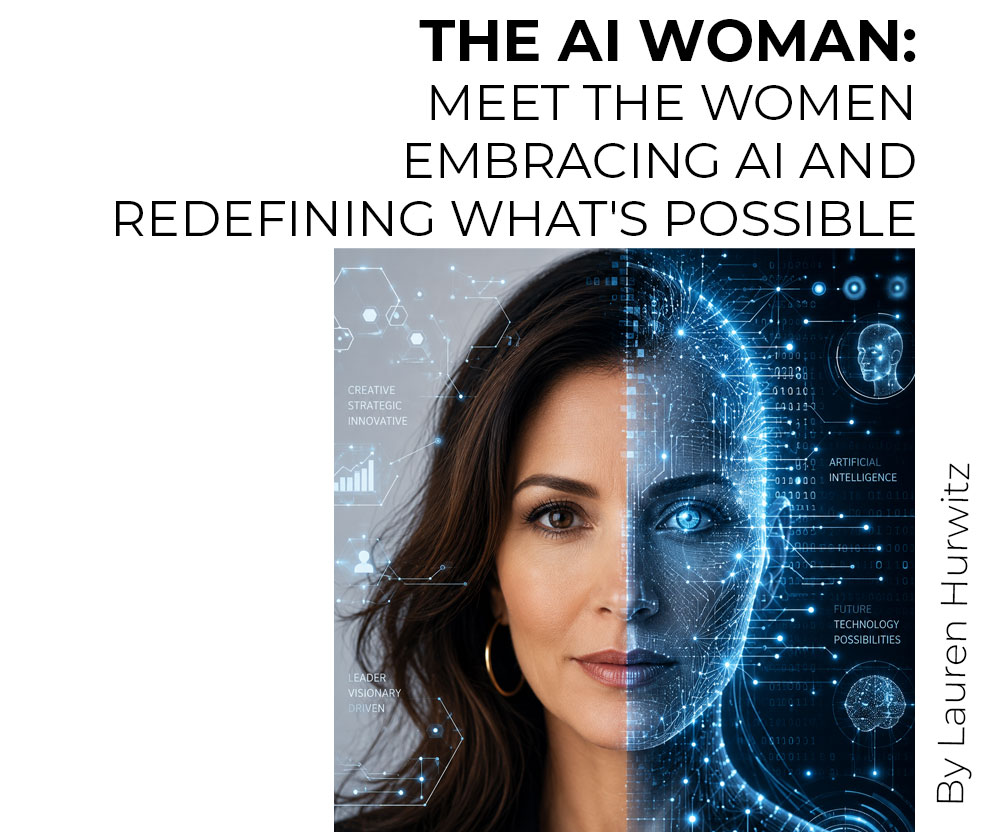
If you’ve spent any time online recently, you’ve likely been bombarded with headlines about Artificial Intelligence. From warnings about job displacement to complex technical jargon, the conversation surrounding AI can feel overwhelmingly intense. But right here in Westchester, local women are adopting AI not as a threat or a party trick, but as an indispensable tool for daily life…and it’s not too late to embrace it!
“The intimidation usually isn’t about the technology -it’s about not knowing what to ask or being afraid of doing something wrong,” says Donna Cravotta, a Mt. Kisco – based AI visibility strategist and founder of Cravotta Media Group. “You cannot break anything, and AI has no judgment. Start with something small and real about your own life. Talk to it like you’d talk to a smart friend who happens to know a lot.”
Rachel Dooley, Chief Innovation Officer at Kirkland & Ellis agrees that we are living through a unique cultural moment. “This is the most exciting period of knowledge development in modern history,” Dooley says. “Everyone needs to learn these skills for the future, both personal and professional, and we are still in early innings. It’s a learn-by-doing moment.”
For busy Westchester women balancing careers, family calendars, household management, and personal pursuits, AI isn’t replacing human effort but rather lightening the mental load.
Real Women, Real Solutions
In New Rochelle, Dana O’Malley, owner of Kindred Public Relations, relies on AI as her daily “chief of staff.” Every morning, she uses AI to synthesize her calendar, to-do lists, and client deliverables into a single, cohesive briefing so she can jump straight into her day without opening a dozen tabs. At home, she uses it to turn chaotic weeknight schedules into structured family meal plans and auto-generated grocery lists, drastically cutting down on food waste and dinner stress.
“It’s also my first stop for practical household advice,” O’Malley notes, using AI for everything from troubleshooting home repairs and planning kids’ birthday parties to researching vacation itineraries. Professionally, she leverages tools like Claude to brainstorm creative story angles and polish media pitches, freeing up energy for high-touch client work.
For small business owners, AI is proving to be the ultimate equalizer. Melissa Panszi Riebe, a New Rochelle resident who works in Dobbs Ferry as the founder of A D’Zine jewelry and the Make Your Mark[et] pop-up marketplace, uses AI as a virtual co-worker.
“As a solopreneur running two businesses, AI gives me a sounding board and strategic partner,” Panszi Riebe explains. “The game-changer for me was finding an AI platform built to preserve your authentic voice, specifically MyStoryPro AI, created by a woman-led team. It takes the guesswork out of back-office operations, translates complex sales analytics into actionable insights, and helps me spot industry trends without losing my human touch.”
What AI Can and Cannot Replace
As more women bring AI into their routines, a common question arises: where does the machine end and the human begin?
According to Dooley, the line is surprisingly clear. “AI is trained on a massive amount of data, but it treats everything as largely equal until a person tells it what matters,” she explains. “That requires taste, judgment, and the ability to weigh facts against context. That will always be human and irreplaceable.”
Rather than asking AI to do the thinking for you, experts suggest using it to challenge and refine your own thought process. Two of Dooley’s favorite prompts when working through a creative or business problem are simple: “Tell me why this is wrong” and “Ask me questions to help you understand how I’m thinking about this so you can explain an angle I’m missing.”
Cravotta recommends starting small with everyday friction points where AI can digest confusing information for you. For instance, uploading complex insurance provider lists or medical group options lets the tool quickly filter which doctors fit your network and criteria. You can also use it to draft quick queries for household fixes, find recipe ingredient swaps, or research local activities. Voice-to-text features on apps like ChatGPT or Claude are especially useful while driving or walking, offering a hands-free way to talk through ideas, outline emails, or organize a list of messy thoughts before you even sit down at your desk.
How to Get Started
If you’re ready to let AI simplify your daily routine, the key is to speak naturally and forget rigid coding commands; the best prompts simply read like a warm conversation with a capable assistant. Give the tool context about who you are, what your goal is, and how you want the output formatted, whether that means asking for a bulleted weekend party checklist or a brief summary of a long document. Remember that you don’t have to settle for the first answer but treat initial responses as rough drafts and iterate by asking the tool to make things shorter, warmer, or more concise.
Crucially, while AI provides the structural foundation for your work and life, you provide the soul. Never input sensitive personal data like financial account numbers or private medical records into public models, and always edit the final output so your unique perspective shines through. At its core, AI isn’t about automating away our daily lives—it’s about buying back our most valuable resource: time. By handing off administrative strain, routine scheduling, and initial drafting to AI, Westchester women are making more room for what truly matters: creativity, community, and connection.